
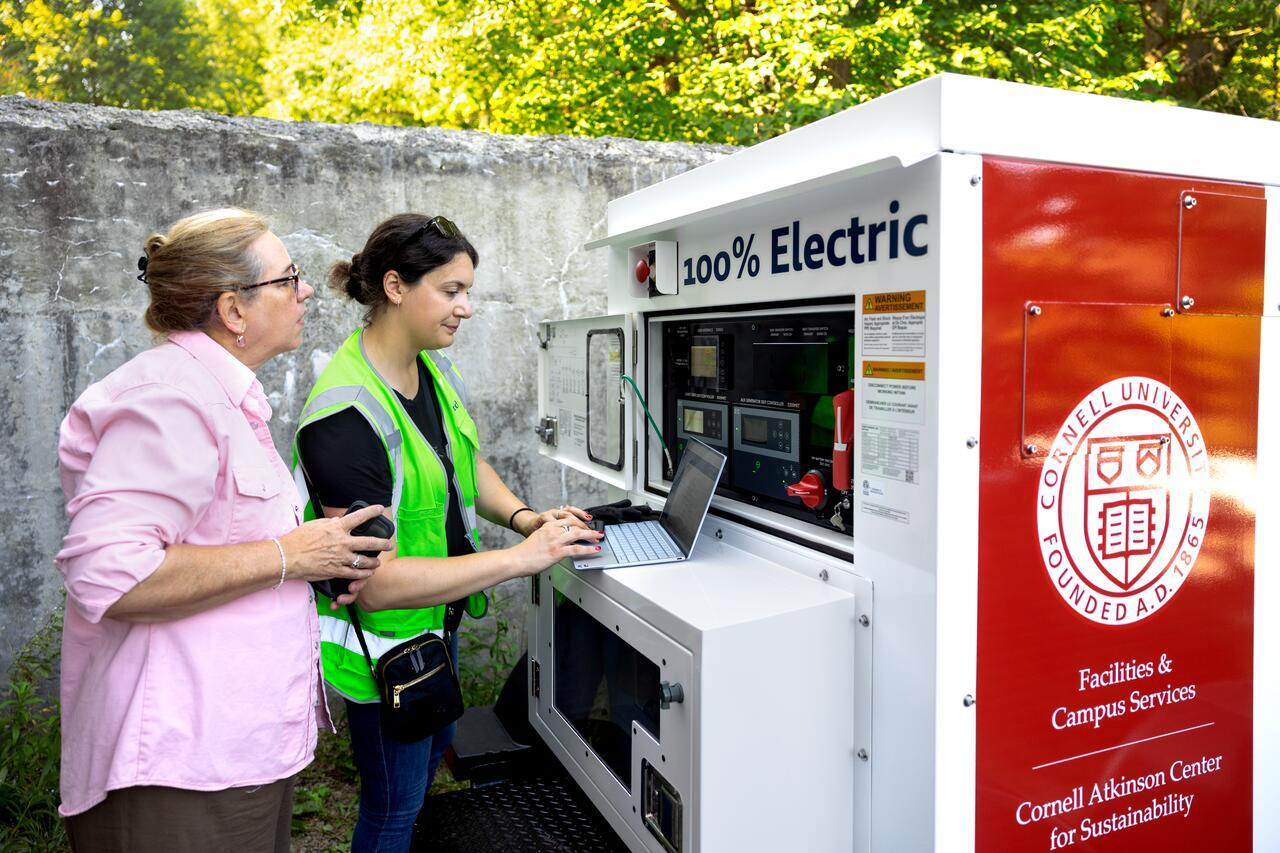
Large outdoor events on Cornell’s campus often include one unsavory but necessary guest: a noisy diesel generator that guzzles gas, emits fumes and costs up to $1,000 a day to rent.
Now a pilot between Cornell, New York state and industry is testing a quiet, clean alternative: an 8.5-by-3-foot mobile battery storage system to power signature events like Slope Day and Commencement, and potentially provide backup power in emergencies.
“Advancing energy storage technology is essential to accelerating the clean energy transition,” said Justin E. Driscoll, CEO of the New York Power Authority (NYPA), which funded the project. “The success of the new mobile battery storage system at Cornell highlights NYPA’s commitment to innovation and to piloting new technologies that can be scaled to drive New York’s energy future.”
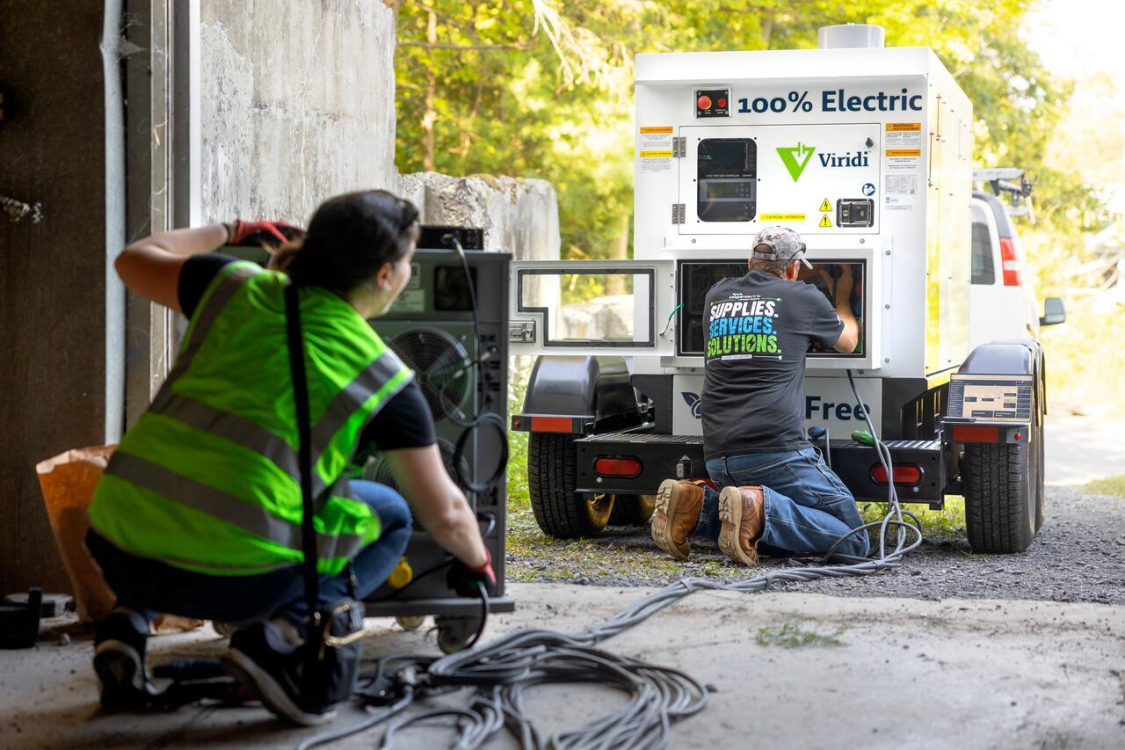
Designed by Buffalo-based energy storage company Viridi, the system is mounted on a trailer for easy transport and can provide 150 kilowatt-hours of electricity, enough to power a small home for days. Housed at Cornell indefinitely, the system will reduce events’ carbon footprint, improve guests’ experience and ease the duties of facilities staff, who won’t need to constantly refuel or run power from nearby buildings, reducing costs and wiring and improving safety.
“It’s going to be awesome,” said Juliet Parsons, associate director of operations and logistics in Cornell Facilities and Campus Services (FCS). “It’s a way to make our events run more smoothly without doing any damage to the atmosphere. We’re gaining a lot and losing nothing.”
A launch event on Nov. 20, on the Ag Quad, celebrated the system’s first use on campus and the collaboration that brought it to Cornell, with a demo of the battery system and remarks from partners. The project has been shepherded by the Cornell Atkinson Center for Sustainability and the Campus Sustainability Office, with crucial collaboration from FCS. The Cornell team worked with NYPA, Viridi and the Electric Power Research Institute (EPRI) – an independent nonprofit that conducts research and development in the energy industry – to secure approvals and permits to store and install the charging infrastructure on campus.
The Viridi system uses lithium-ion cells but is specially designed to prevent “cascading thermal runaway,” or the spread of heat between battery cells, that can lead to fires.
“It’s a failsafe, passive system,” said Tess M. Williams ’15, project manager for Viridi, who helped connect the company with Cornell. “The zombie apocalypse could hit, cell service could go down, this thing could roll off your truck, it could get hit with a forklift – it’s still going to work.”
The system has been cETLus-listed, a gold-standard safety certification required for electronics, like laptops and cell phones, in the U.S. and Canada. More than 300 units have been deployed across North America.
NYPA and EPRI will track the system’s performance across different use cases as well as the cost and carbon savings. The team is also learning from the process to approve and permit the battery system.
“The electric utility industry worldwide is the most complicated industry, no question. Every state has different regulations,” said Eva Gardow, an EPRI program manager and the technical lead on the pilot. “We want to understand the safety around it, the regulations, the permitting, the codes and standards and all of the nuances so we can smooth the adoption of these fully renewable technologies.”
Cornell faculty are brainstorming ways to incorporate the battery into their research, and FCS hopes to explore uses for additional units – possibly even replacing or supplementing the nearly 100 diesel generators that currently serve as backup at various buildings across campus.
“We’re getting to the point where the maintenance on some of these generators is more than buying a new one,” said Jeff LaPar, electric enterprise manager for FCS. “We may be able to start considering these as more of a fixed unit than a mobile one.”
Williams sparked the collaboration at an alumni event in Buffalo, where she heard Cornell Atkinson’s director David Lodge speak about energy storage. She said bringing her company’s product back to Cornell connects two very positive parts of her life. “It means a lot,” she said.
The project also serves as an exemplar for Cornell Atkinson, which aims to build partnerships that accelerate the adoption of sustainable solutions to climate change. Cornell Atkinson’s Shaun Doherty said the project is special because of the different types of partners involved.
“I’m excited about the relationships we’re building with NYPA and EPRI, and I’m excited that Facilities is excited,” said Doherty, the lead for energy transition and carbon management partnerships. “This will really help us in our mission in terms of sustainability, but it’s also just a better solution for them. It’s a double benefit.”
Parsons agreed. “Working with all of these folks outside our normal day-to-day business has been such a wonderful experience,” she said. “Knowing that we have a seat at the table, that we can offer our opinions and help move things along makes us feel really good about our place on campus and the why of what we do.”